How Radio Connected the World · Episode 01 · 8:44
How a Giant Machine Sent Messages Across the Atlantic | Grimeton
A spinning rotor, six towers and a message bound for the other side of the Atlantic.
 Watch on YouTube 8:44
Watch on YouTube: How a Giant Machine Sent Messages Across the Atlantic | Grimeton
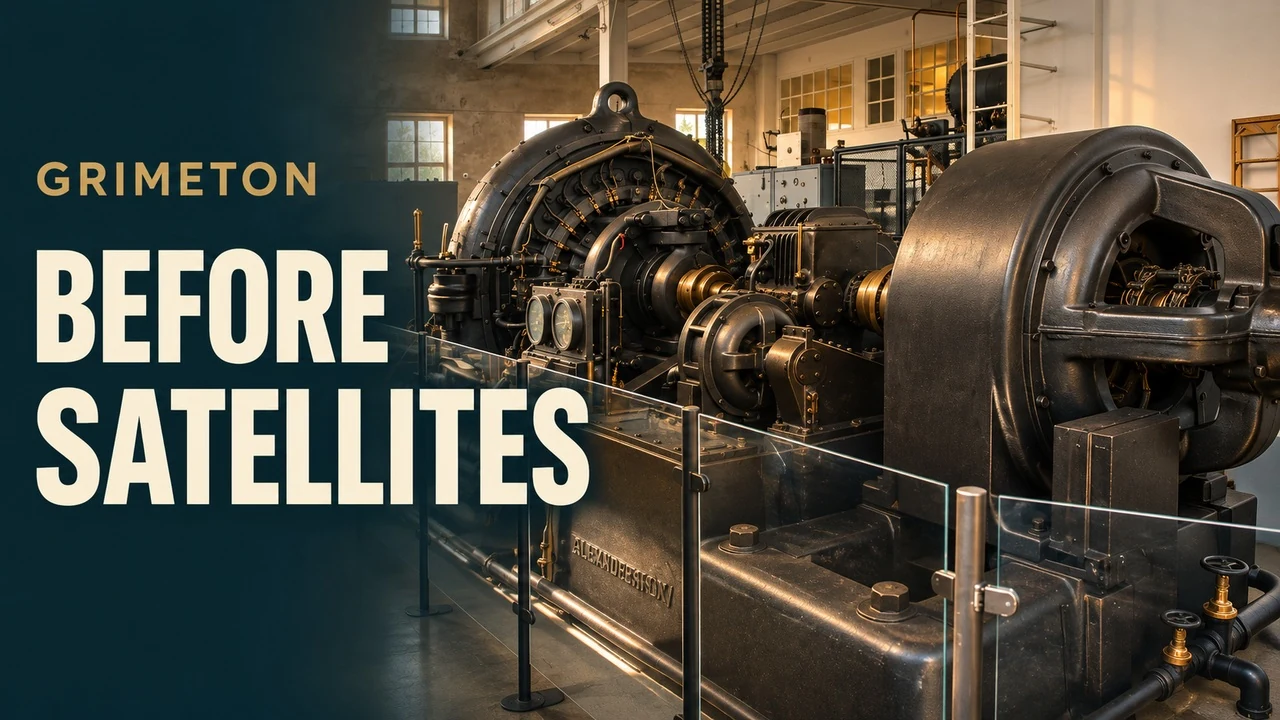
Before a voice could cross an ocean, a machine had to make the wave. At Grimeton in Sweden, an Alexanderson alternator turned mechanical motion into a radio-frequency current. The station entered commercial service in December 1924; its surviving machinery lets us look inside a very different communications network. [1]
Follow the energy
A motor drives a gearbox. The gearbox spins the alternator. Its changing magnetic field produces an electrical carrier that can be keyed to carry Morse messages. The antenna system then couples that energy into the surrounding space. Those are connected stages, but they are not interchangeable: the machine’s rated output is not the same as the power effectively radiated by the antenna. [2]
The six towers are the most visible part of the installation. The transmitting system also depends on conductors, tuning components and an extensive earth system. A photograph of the towers alone cannot explain how the station worked.
A connection with two ends
Grimeton belonged to a transatlantic network. On the American side, reception at Riverhead and transmission from Rocky Point were separate functions and places. Thinking in terms of a network helps us see beyond a single spectacular machine. [1]
Look more closely
Watch for the transition from rotating steel to an invisible signal. The film’s simplified diagrams guide the eye; they are not complete engineering drawings. Grimeton’s preservation also matters: UNESCO recognises the station as evidence of an early system for wireless transatlantic communication. [3]
Sources and context
These are our summaries of the sources and their role in this article. Follow the numbered markers above to find the relevant note.
The Alexander Association - The Radio Station SAQ Grimeton
The association describes the creation of the Swedish station and its place in transatlantic communications. We use it to connect the surviving installation with the network it served, including the distinction between transmitting and receiving locations. It is a preservation organisation’s account of its own site. Its chronology is useful context, while detailed engineering claims should also be read against the technical description.
The Alexander Association - The Alexanderson transmitter
This account follows the driving motor, gearbox and high-frequency alternator, with the antenna and associated equipment forming the wider transmitting system. We use it to explain how mechanical motion became a carrier for messages. The description concerns a particular installation: a simplified graphic in our film is a guide through its stages, not a substitute for the machinery’s full electrical and mechanical documentation.
UNESCO World Heritage Centre - Grimeton Radio Station, Varberg
UNESCO places Grimeton within the history of wireless transatlantic communication and describes its preserved transmitter and antenna installation. The listing helps explain why the site matters beyond the spectacle of a large machine. Heritage significance and operational engineering answer different questions. We use this source for the site’s historical importance, rather than as a circuit diagram or a present-day transmission schedule.
Images and further reading
The poster is an illustration, not archival evidence. Sources & Methods explains our use of photographs, diagrams and reconstruction, including poster credits. The sources above support this companion article; they are not a complete inventory of every image in the film.
Continue with How shortwave radio used the sky, explore the Glossary, or return to all six episodes.