How Radio Connected the World · Episode 06 · 8:48
Why Shortwave Radio Still Matters | Beyond the Internet
QSL cards, disaster recovery and the people who keep a connection alive.
 Watch on YouTube 8:48
Watch on YouTube: Why Shortwave Radio Still Matters | Beyond the Internet
A small card can make a distant listener real to a broadcaster. This final episode begins with a remembered encounter and asks where shortwave remains useful when other communications systems have become dominant.
A memory is not a recovered photograph
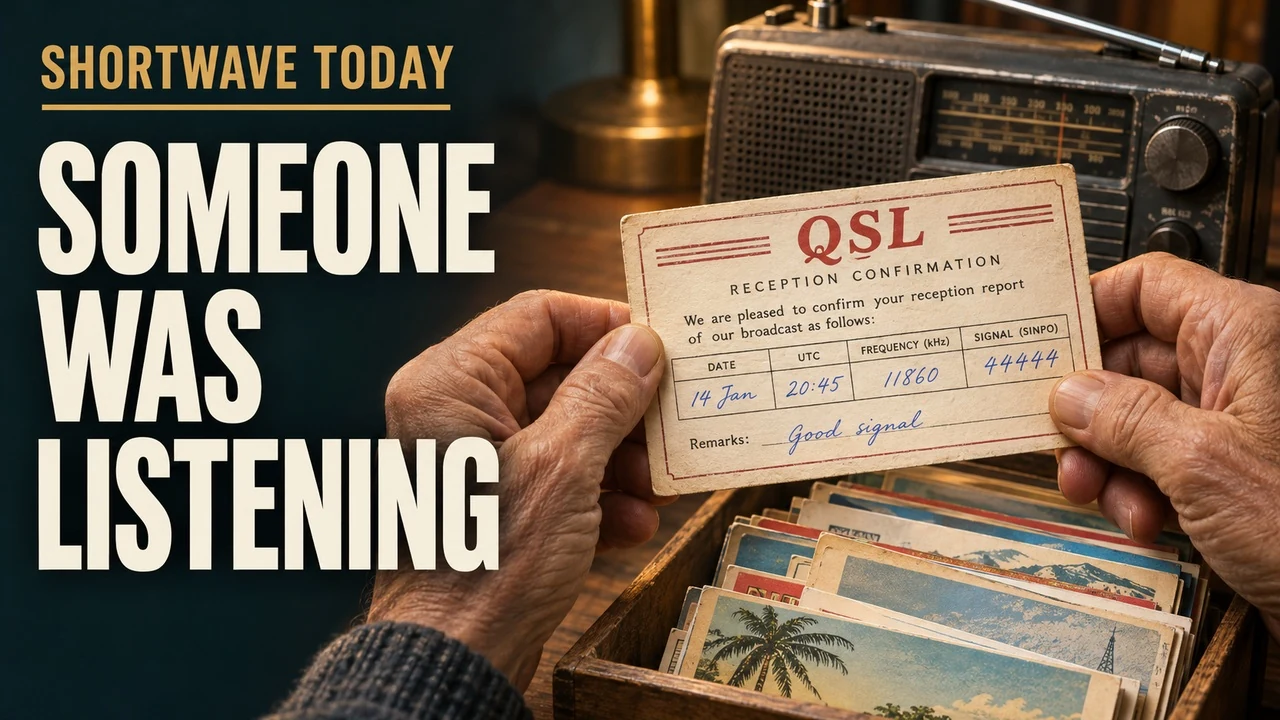
Jeff White’s account of meeting a listener gives the film a human point of entry. It is an interview recollection. Illustrative scenes built around the story are not footage of the remembered event, and a generated signature or reception card cannot authenticate it. [1]
A QSL card confirms a reception report or, in amateur radio, a radio contact. Those are different practices. A colourful amateur card can illustrate the wider culture, but it should not be passed off as evidence of listening to a broadcast station. Nor does one card measure the size of an audience.
Vanuatu: restoring a way to reach people
After Cyclone Pam in March 2015, the work of restoring broadcasting in Vanuatu involved local staff and outside technical assistance. The recovery record makes a useful case study because it describes practical repairs and communications needs. [2]
We do not infer that one medium alone explains survival or the disaster’s death toll. Research on the response examines several contributing factors. [3]
Useful does not mean universal
A shortwave receiver can receive a direct broadcast without an internet connection at the listening end. It still needs power, an antenna, a suitable frequency and a signal that reaches it. Propagation changes with conditions in the ionosphere; shortwave is not a promise of reception everywhere, all the time. [4]
Investment has also continued. The new RNZ transmitter reported at Rangitaiki in 2024 is one example of renewal rather than a universal revival. [5] This is why the series ends with people maintaining a connection, not with a claim that one technology has won.
Before the repairs: the moment of warning
ABC’s contemporary reporting describes evacuation preparations as Cyclone Pam approached Vanuatu. It supplies a view of uncertainty before the full damage was known, distinct from a later account of technical recovery. [6]
Sources and context
These are our summaries of the sources and their role in this article. Follow the numbered markers above to find the relevant note.
Radio Prague International - Jeff White on why shortwave radio still matters: HFCC Conference in Prague
Jeff White discusses his involvement in shortwave and recalls the people and encounters that gave distant listening a personal meaning. We use the interview as testimony about that experience and his perspective on the medium. A remembered encounter is not a recovered film record. Our illustrative scenes should not be mistaken for photographs of the original event, and a personal account alone cannot establish audience size.
ITU meeting material - Disaster recovery: Vanuatu case study
The presentation sets out disaster impacts and recovery issues after Cyclone Pam in Vanuatu. We use it to place communications repair within a practical emergency response involving damaged infrastructure and limited resources. The slides combine institutional information and credited photographs, which have their own origins. Their figures are dated assessments; the presentation does not establish that a single medium explains the disaster’s outcomes.
Australian Journal of Emergency Management - Cyclone Pam in Vanuatu: learning from the low death toll
The authors investigate possible reasons for the relatively low recorded death toll despite severe damage. Their discussion considers warnings, community action and features of the cyclone, rather than attributing the outcome to one technology. We use the article to keep the radio story within that wider context. It supports questions about preparedness and response, not a simple claim that shortwave broadcasting alone saved a measurable number of lives.
NOAA Space Weather Prediction Center - HF Radio Communications
NOAA describes how space weather and the ionosphere affect radio propagation, including disruptions to HF communication. We use it to explain why a receiver without an internet connection still depends on a viable radio path. The page provides physical context, not a guarantee of reception at a particular place or time. A service can be useful during disruption while remaining subject to changing conditions and practical receiver requirements.
AIB - RNZ fires up new transmitter to cover the Pacific
This report describes RNZ’s investment in a replacement shortwave transmitter at Rangitaiki, capable of analogue and digital operation. We use the dated announcement as an example of renewal alongside the closures discussed elsewhere in the series. An inauguration report is not a live operational status check. It also does not imply that every ordinary analogue receiver can decode a digital broadcast or that investment was universal across broadcasters.
ABC News - Cyclone Pam: Vanuatu issues evacuation alerts as category-five storm wreaks havoc across the Pacific
ABC News reported evacuation preparations in Vanuatu as Cyclone Pam approached in March 2015. Residents in Port Vila stocked up on food while authorities warned about flash flooding and landslides. The report captures the uncertainty and practical decisions before the storm. We use it to establish that contemporary setting; it does not, by itself, demonstrate how radio repairs later affected the recovery or establish the outcome of the evacuations.
Images and further reading
The poster is an illustration, not archival evidence. Sources & Methods explains our use of photographs, diagrams and reconstruction, including poster credits. The sources above support this companion article; they are not a complete inventory of every image in the film.
Continue with Return to Grimeton, where our series began, explore the Glossary, or return to all six episodes.