How Radio Connected the World · Episode 03 · 12:09
Wertachtal: The Giant Antenna Forest That Broadcast to the World
The cables, switching and human decisions behind a vast shortwave transmitting station.
 Watch on YouTube 12:09
Watch on YouTube: Wertachtal: The Giant Antenna Forest That Broadcast to the World
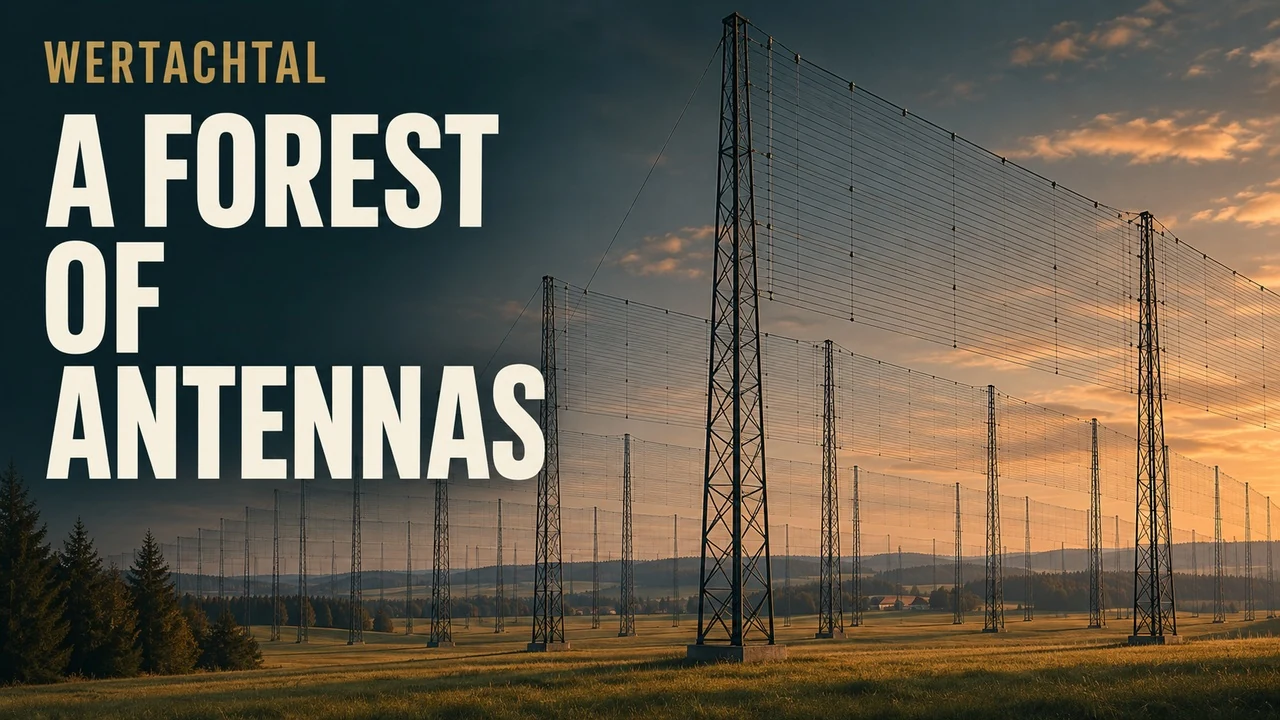
At Wertachtal, the forest was made of steel and wire. The Bavarian station began broadcasting in June 1972. Its scale makes a striking image, but scale alone does not explain the work: a programme needed the right transmitter, frequency and antenna for its intended audience. [1]
A station is a set of choices
A curtain antenna directs energy towards a region rather than spreading it equally in every direction. Its pattern is not a perfectly bounded beam. Frequency, propagation and antenna choice work together; drawing a bright line on a map is only a conceptual explanation. [3]
The feed system between the hall and the antennas was part of the machine. A surviving cross-section of feeder cable in the Museum Foundation Post and Telecommunications collection makes that connection tangible. [2]
Read the numbers in their year
Contemporary reports describe the initial installation, its planned staffing and equipment. Those figures should not silently become an inventory of the station decades later. The film treats the 1972 starting configuration as a dated snapshot, not a permanent specification. [1]
When the network changes
Regular operations ended in 2013, followed by dismantling in 2014. That ending is part of this station’s history. It does not establish that shortwave broadcasting disappeared everywhere. The later episodes follow different outcomes: a newsroom finding new routes and broadcasters continuing to invest in radio. [4]
Sources and context
These are our summaries of the sources and their role in this article. Follow the numbered markers above to find the relevant note.
Funk-Technik / World Radio History - Funk-Technik, issue 13/1972
The contemporary report describes Wertachtal around its opening, including the installation and work needed to operate it. We use that dated starting point to make the station’s organisation concrete. Opening-period figures are not a permanent inventory: later additions, staffing changes and closure belong to other stages of the history. The publication is preserved by World Radio History, which provides access to the scanned issue.
Museumsstiftung Post und Telekommunikation - Hochfrequenz-Senderkabel “50-97/230 AL”, Scheibenmuster
The museum record documents a cross-section of high-frequency coaxial feeder cable used at Wertachtal. It makes the connection between transmitters and antennas tangible: the feed system was part of the installation, not empty space between its visible landmarks. We use the object record to discuss that material infrastructure. This is a cable specimen, not a scale model of the station or an inventory from its final year.
ITU-R - BS.80-3: Transmitting antennas in HF broadcasting
The recommendation addresses antenna choice, directional coverage and radiation outside the intended service area. We use it to explain why a curtain antenna’s pattern is more complex than a narrow line on a map. It provides engineering context, not a record of a particular Wertachtal transmission. A diagram indicating direction should therefore be read as a simplified explanation, not a claim of exact geographic boundaries.
WELT / dpa - Kurzwellensender wird in Schwaben nach 42 Jahren abgebaut
This report covers the dismantling of Wertachtal and quotes the operator’s account of the end of regular service. We use it for the station’s closing phase, distinguishing news reporting and attributed statements from the earlier engineering record. Closure at one site is not evidence that the medium disappeared everywhere. The film follows this local ending with other broadcasters’ choices about continuing or changing distribution.
Images and further reading
The poster is an illustration, not archival evidence. Sources & Methods explains our use of photographs, diagrams and reconstruction, including poster credits. The sources above support this companion article; they are not a complete inventory of every image in the film.
Continue with Voices, power and the Iron Curtain, explore the Glossary, or return to all six episodes.