How Radio Connected the World · Episode 02 · 10:14
How Shortwave Radio Used the Sky to Reach the World
How a changing layer of the upper atmosphere became part of a worldwide radio network.
 Watch on YouTube 10:14
Watch on YouTube: How Shortwave Radio Used the Sky to Reach the World
What if a transmitter could reach beyond the horizon without a cable laid across the sea? Shortwave radio made the upper atmosphere part of the path. But that path was never a fixed piece of infrastructure.
A changing route
The ionosphere contains electrically charged particles that affect radio propagation. Under suitable conditions, a shortwave signal can be refracted back towards Earth. Frequency, time of day, season and solar activity all matter. “Bouncing off the sky” is a useful first image, but a rigid mirror is a misleading model. [1]
This also explains why a station can sound strong, fade and return. More than one path can reach a receiver, and those signals can reinforce or weaken one another. A worldwide service had to plan around variability rather than assume constant reception.
An early milestone needs a qualification
The film looks back to the 1921 transatlantic amateur tests and Paul Godley’s reception in Scotland. The celebrated 1BCG signal was around 230 metres, roughly 1.3 MHz. In modern terminology that is medium frequency, outside today’s 3–30 MHz HF band. Historical use of “short wave” and the present band definition should not be confused. [2]
From experiment to service
The BBC’s early international broadcasting provides one example of the move towards scheduled services. Its engineering records let us examine transmitters and operating decisions rather than tell a story of inevitable progress. International broadcasting also carried the political and colonial assumptions of its time. [3]
Sources and context
These are our summaries of the sources and their role in this article. Follow the numbered markers above to find the relevant note.
ITU-R - BS.2251: Digital Radio Mondiale in the 26 MHz band
This report examines digital broadcasting in the 26 MHz band. Its propagation annex provides technical context for how radio signals travel under changing atmospheric conditions. We use that discussion selectively; the document is not a general history of shortwave broadcasting. Its main planning problem concerns a particular band and system, so its conclusions should not be applied unchanged to every frequency or historical network.
ARRL - Transatlantic Tests Mark 99th Anniversary
ARRL revisits the amateur transatlantic tests and Paul Godley’s reception of station 1BCG in Scotland. We use it to introduce the experimental work behind later long-distance services. Its historical use of “shortwave” needs a qualification: the roughly 230-metre signal belongs to the medium-frequency range in modern terminology. A milestone in reception is also not evidence that every subsequent path would be reliable.
BBC Research & Development - BBC Engineering, issue 84
This archived engineering publication supplies institutional context for the development of BBC international broadcasting. We use it alongside the film’s historical account to think about equipment and organised services rather than isolated discoveries. It is a retrospective engineering source, not a contemporary recording of the earliest broadcasts. Dates and equipment descriptions must remain attached to the period being discussed.
Images and further reading
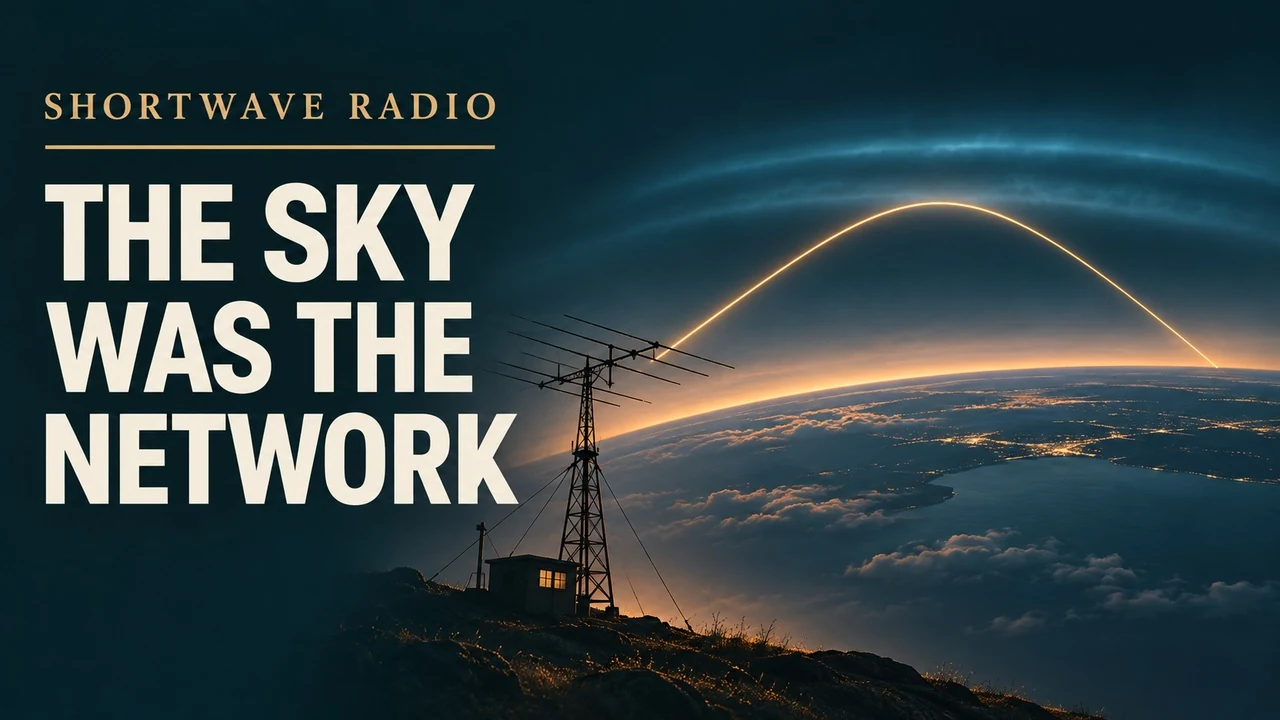
The poster is an illustration, not archival evidence. Sources & Methods explains our use of photographs, diagrams and reconstruction, including poster credits. The sources above support this companion article; they are not a complete inventory of every image in the film.
Continue with Inside Wertachtal’s antenna forest, explore the Glossary, or return to all six episodes.